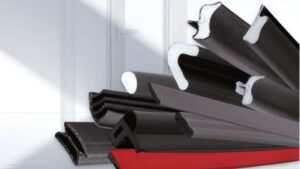
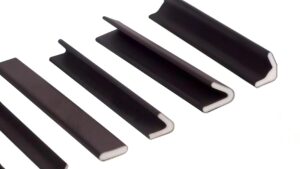
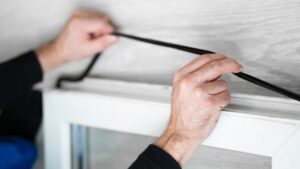
Small gaps around a fire door can become paths for flames, hot gases, and smoke. An intumescent fire seal solves this problem by remaining compact during normal use and expanding when exposed to high heat. Expanded graphite is widely used in these seals because it can form a stable carbon barrier that fills the gap between the door and frame.
To achieve reliable protection, you must match the material, seal dimensions, carrier structure, and installation method to the tested fire-door system.
How Expanded Graphite Creates a Fire Barrier
An intumescent seal is a passive fire-protection component. Heat from a fire triggers its expansion.
The Layered Structure of Expandable Graphite
Natural graphite consists of thin carbon layers stacked closely together. To make expandable graphite, chemical compounds are inserted between these layers. This process creates a graphite intercalation material.
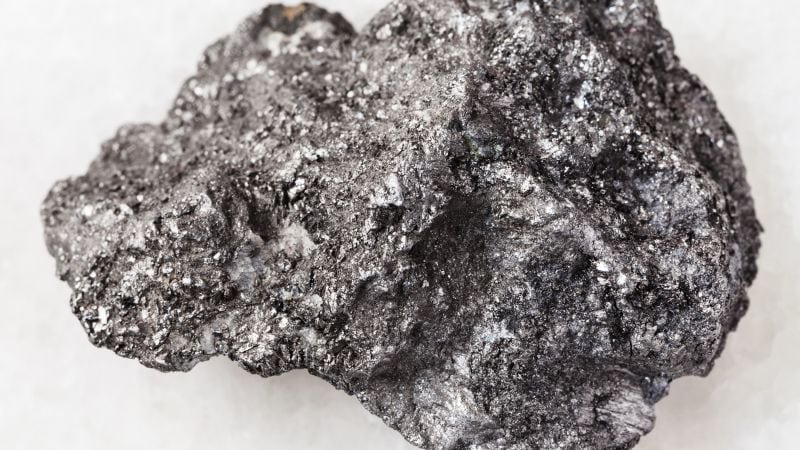
When the material is heated, the compounds trapped between the layers break down and release gases. The pressure forces the graphite layers apart. Individual graphite flakes can then expand into long, lightweight, worm-like structures.
The increase in volume can be substantial. The exact starting temperature and expansion ratio depend on the graphite grade, particle size, treatment process, and seal formulation.
Expansion Fills the Door Gap
During normal use, a fire door requires a small clearance so it can open and close without rubbing against the frame. During a fire, that same clearance can allow flames and hot gases to pass into the next compartment.
As the graphite core expands, it pushes outward into the available space. The expanded material forms a dense carbon-based residue that bridges the gap between the door leaf and frame.
This expanded barrier performs several connected functions:
| Fire condition | Response of the graphite seal | Protective result |
| Temperature rises | Intercalated graphite begins to expand | The passive seal becomes active |
| Graphite volume increases | The door gap is progressively filled | Open paths around the door are reduced |
| Carbon barrier forms | Heat and flame movement are restricted | Fire spread between compartments is delayed |
| Char remains in the joint | Hot gases face greater resistance | The doorset maintains its barrier function longer |
| Heat transfer is reduced | The unexposed side heats more slowly | Occupants gain more evacuation time |
Why the Expanded Barrier Resists Fire
The expanded graphite structure contains many small air spaces. These spaces help slow heat transfer. At the same time, the carbonized mass remains more stable than an ordinary plastic or foam seal exposed to intense heat.
The seal closes a vulnerable route and helps the tested doorset maintain compartmentation.
This distinction matters. An intumescent strip is only one part of a fire-door assembly. The door leaf, frame, hinges, closer, latch, glazing, hardware, gaps, and seals must work together.
Fire Sealing and Cold-Smoke Sealing Are Different
Expanded graphite needs heat before it expands. It therefore cannot, by itself, close a door gap against cool smoke during the early stage of a fire.
When ambient-temperature smoke control is required, you normally need a combined intumescent and smoke seal. The additional smoke component may use a flexible blade, brush, or compressible gasket that closes the gap before the graphite activates.
Industry guidance distinguishes heat-activated intumescent strips from cold-smoke seals. It also warns that seal materials, expansion rates, and installation requirements vary by manufacturer. You must use a seal covered by the door manufacturer’s test evidence.
How to Select and Install an Intumescent Fire Seal
A profile that does not match the door gap or groove can interfere with closing, become damaged, or fail to expand in the required direction.
Compare Seal Structures
Winguard’s fire-seal range includes coated intumescent seals, PVC-carrier seals, and PVC+EVA profiles. The carrier protects and positions the active core during everyday use.
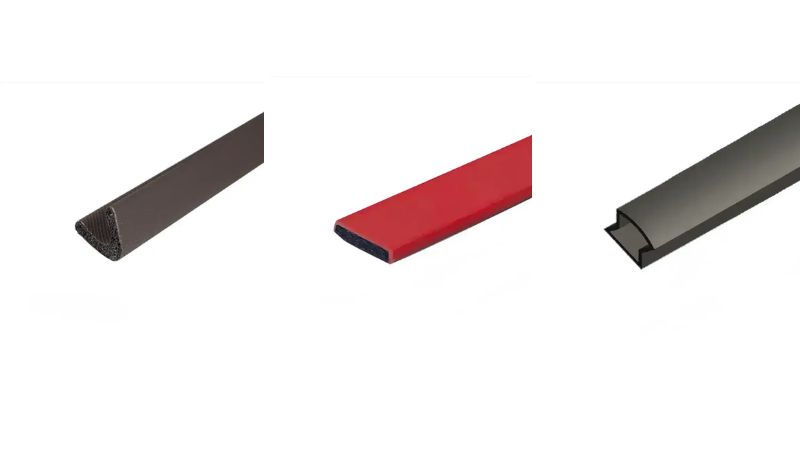
| Seal structure | Normal-use performance | Typical advantage | Point to check |
| Coated PU foam | Soft and compressible | Quiet closing and impact absorption | Correct compression range |
| PVC carrier | Firm and dimensionally stable | Strong wear and groove protection | Exact channel dimensions |
| PVC+EVA carrier | Stable with added flexibility | Balance of durability and cushioning | Profile thickness and hardness |
| Combined smoke configuration | Closes the gap before heat activation | Early smoke control | Doorset smoke-test evidence |
The outer carrier affects wear resistance and installation, but the intumescent core provides the heat-triggered expansion. You should select the full profile as one tested component.
Match the Profile to the Door System
Before choosing a seal, confirm the required fire rating, smoke rating, door material, groove dimensions, gap size, and opening method. Measure the gap at several points because doors and frames are rarely perfectly uniform.
You should also check whether the seal is intended for:
- A swinging or sliding door
- An entrance or interior door
- Surface, butt-seal, or mortised installation
- A timber, metal, composite, or glazed doorset
- Single or double-leaf construction
Do not cut away part of the carrier simply to make a profile fit. Do not stretch the seal during installation. Corners and joints should remain continuous according to the supplier’s instructions and the doorset documentation.
Verify Performance Through Testing
Expansion ratio alone does not prove that a seal is suitable for your door. A material may expand greatly in an open laboratory test but behave differently when restricted inside a narrow groove.
You should ask for evidence related to the complete configuration, including seal size, installation position, substrate, door construction, and test duration.
Regular inspections are also essential. Replace strips that are missing, loose, cut, painted over, hardened, or mechanically damaged. Confirm that the door still closes fully and that the perimeter gaps remain within the permitted range.
Choose Winguard for Intumescent Sealing Products
Winguard’s quality controls include raw-material testing, swelling tests, hardness checks, expansion-ratio testing, archived production formulas, and retained samples for batch traceability. We also provide OEM and ODM support for customized cross-sections, dimensions, colors, hardness, and lengths.
Contact us today to develop a fire-sealing profile matched to your door gap, carrier structure, installation method, and performance target.
Recommended Winguard Fire-Seal Models
The following models cover several profile sizes and carrier structures.
- XHM225F Coated Intumescent Seal — Model XHM225F: A wide 25 mm polyurethane foam butt seal for narrow clearances of 1.0–1.8 mm. Its broad contact surface suits large doors that also require soft compression.
- XHM218F Coated Fire-Retardant Butt Seal — Model XHM218F: A 13 mm coated profile for gaps from 4.8 to 6.5 mm. The resilient foam helps absorb closing impact on swinging and sliding doors.
- XHF306 PVC Intumescent Seal — Model XHF306: A wide 20 × 2 mm PVC-carrier strip for commercial and industrial door assemblies. Its rigid exterior supports shape retention in high-traffic settings.
- XHF307 Deep-Groove PVC Intumescent Seal — Model XHF307: An 18 mm profile designed for a 7.5 mm-wide and 8 mm-deep groove. It is suitable when you need secure recessed installation and strong mechanical protection.
- XHF19 PVC+EVA Intumescent Seal — Model XHF19: A compact 9 × 7 mm profile combining PVC stability with EVA cushioning. It suits installations with limited surface width but greater profile depth.
- XHF26 Heavy-Section PVC+EVA Fire Seal — Model XHF26: A substantial 12 × 12 mm seal for fire doors and windows that require greater edge coverage and a fuller sealing body.
Frequently Asked Questions
At What Temperature Does Expanded Graphite Activate?
There is no single activation temperature for every formulation. Commercial graphite grades can have different expansion-onset temperatures. Winguard’s listed intumescent products describe heat activation beginning after temperatures exceed approximately 200°C, with model-specific expansion information provided on individual product pages.
Does Expanded Graphite Produce an Airtight Seal?
It can create a dense barrier under fire conditions, but the result depends on the available expansion pressure, gap size, carrier, and door construction. You should avoid describing an untested product as completely airtight.
Can an Intumescent Seal Stop Cold Smoke?
Not by heat expansion alone. Cold-smoke protection normally requires a brush, blade, or compressible smoke-sealing component that works at ambient temperature. A combined seal may provide both functions.
Can You Replace a Damaged Strip with One of the Same Size?
Not automatically. Products of equal size may use different materials, expansion pressure, activation temperatures, and expansion directions. The replacement should match the tested doorset specification.
Is More Expansion Always Better?
No. Excessive pressure may damage some door leaves, hardware, or glazing systems. The correct expansion behavior is the one covered by the fire test for the complete assembly.