A weather strip directly affects air leakage, water resistance, noise control, closing force, and long-term user experience.
If you manufacture doors or windows at scale, you need a supplier that can keep dimensions, materials, hardness, and sealing performance consistent from one production batch to the next.
Here are the main factors you should evaluate before selecting a weather strip manufacturer.
What Should You Evaluate in a Weather Strip Manufacturer?
Check Real Manufacturing Capability
First, confirm whether the supplier actually manufactures the weather strips.
A real factory should be able to show you its production equipment, workshops, testing facilities, and manufacturing processes.
Depending on the type of seal, production may involve:
- Raw-material preparation
- Extrusion
- Foam molding
- Coating
- Adhesive bonding
- Cutting
- Coiling
- Inspection
- Packaging
This matters because direct manufacturing gives the supplier more control over production parameters.
It also makes technical discussions easier when something needs to be changed.
For example, if a mounting foot does not fit your door-frame groove correctly, the manufacturer should be able to review the extrusion tooling and profile dimensions. If the closing force is too high, the supplier may need to review hardness, foam density, or cross-sectional geometry.
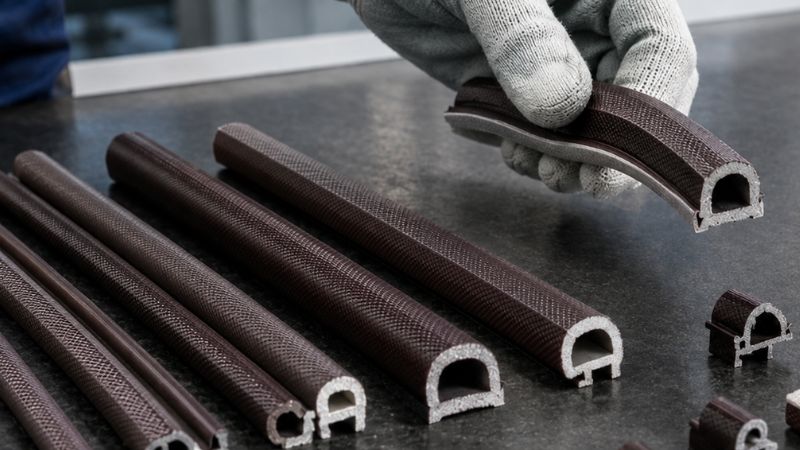
Winguard operates a factory of more than 10,000 m² with 30 independent production lines. The manufacturing areas include raw-material mixing, semi-finished extrusion, PU molding, and product bonding.
Review the Manufacturer’s Product Range and Material Knowledge
Not every weather strip is suitable for every door or window.
Depending on your application, you may use:
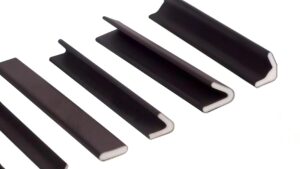
- Coated PU foam weather strips
- TPE profiles
- Intumescent fire seals
Winguard’s product portfolio includes coated weather strips for doors and windows, TPE seals, and several types of intumescent fire seals.
A supplier with a wider sealing-product range can help you compare solutions rather than pushing one material for every project.
Ask your supplier why a particular material is recommended.
You should receive an answer based on your application, such as compression, temperature, weather exposure, groove design, required durability, and door-closing force.
Evaluate Custom Profile Development
Standard weather strips are suitable for many door and window systems. However, your frame design may require a unique cross-section.
A strong manufacturer should be able to work from:
- 2D drawings
- 3D drawings
- Existing samples
- Groove dimensions
- Door-frame drawings
Before tooling begins, discuss the profile width, height, mounting foot, sealing bulb, material, hardness, tolerances, color, and required length.
You should also ask whether the manufacturer can make sample adjustments after your first installation test.
Winguard supports OEM and ODM production and can customize cross-section, dimensions, color, hardness, and length according to customer drawings or physical samples.
This capability is especially important if you develop your own door or window systems.
Examine Quality Control and Batch Consistency
A good first sample does not guarantee reliable mass production.
If you use the same seal across thousands of doors, consistency becomes critical.
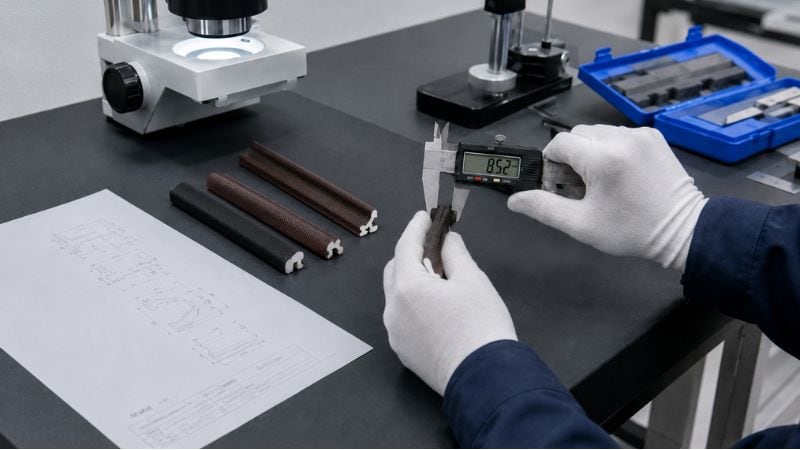
Ask how the manufacturer controls:
- Raw materials
- Profile dimensions
- Foam density
- Material hardness
- Compression behavior
- Adhesive quality
- Surface appearance
- Color
- Roll length
- Batch identification
You should also ask whether approved formulas and samples are retained for future production.
Winguard’s key specifications such as foam density follow customer-approved samples. Fixed formulas are archived for mass production. We also retain labeled samples with batch, carton, and roll information to support traceability.
Our in-house inspection capabilities include raw-material testing, swelling-ratio testing, hardness testing, and expansion testing for fire-sealing products.
| Supplier factor | What you should check | Why it matters |
| Manufacturing | Factory, equipment and production lines | Controls production directly |
| Material options | PU, TPE, EPDM, silicone, rubber, etc. | Helps match the seal to your application |
| Customization | Drawings, samples and tooling support | Supports proprietary frame designs |
| Quality control | Dimensions, hardness, density and materials | Improves batch consistency |
| Traceability | Batch and retained sample records | Helps investigate quality issues |
| Samples | Trial production before bulk orders | Lets you test actual fit |
| Production capacity | Equipment and line availability | Supports repeat large-volume orders |
| Delivery | Standard and custom lead times | Protects your production schedule |
| Technical support | Engineering and application review | Reduces specification mistakes |
How Do You Compare Weather Strip Suppliers Before Ordering?
Test Samples in Your Actual Door or Window
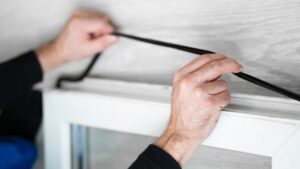
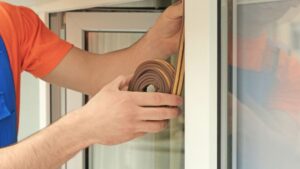
Request samples and test them in the actual door or window system.
You should check:
- Groove fit
- Installation force
- Compression
- Closing force
- Corner performance
- Surface appearance
- Adhesive performance, if applicable
- Recovery after repeated compression
You should also test different points within your expected frame tolerances.
A profile that works perfectly in a 4 mm gap may behave differently when the production gap reaches 5 or 6 mm.
For a new profile, test a full door or window whenever possible. A short sample pressed by hand cannot reproduce the compression around a complete frame.
Compare MOQ and Lead Time With Your Production Plan
You should consider whether the supplier can support your complete purchasing cycle:
sampling → trial order → production order → repeat orders
Ask separately about standard and customized products.
Winguard lists a typical lead time of 7–15 days for standard products. Customized products requiring new molds generally take around 20–30 days, depending on quantity and complexity.
Your actual project schedule should always be confirmed before placing an order.
Look Beyond the Unit Price
When you compare quotations, calculate the total sourcing risk.
A very cheap weather strip is not economical if it creates:
- High installation rejection rates
- Loose groove fit
- Excessive door-closing force
- Material inconsistency
- Production stoppages
- Customer complaints
- Frequent replacements
For long-term door and window programs, consistency can be worth more than a small unit-price difference.
Ask suppliers how they handle repeat orders. The formula, dimensions, color, and packing specification should remain linked to the approved version.
Choose a Supplier That Can Grow With Your Program
You may begin with one weather-strip model. Later, you may need different seals for windows, entrance doors, interior doors, acoustic applications, or fire-rated systems.
Working with a manufacturer that already has several production technologies can simplify future sourcing.
You should also consider whether the manufacturer has enough capacity to support higher order volumes if your sales grow.
Choose Winguard as Your Weather Strip Manufacturer
If you need a long-term manufacturing partner, Winguard combines production capacity, customization, quality control, and a broad sealing-product portfolio.
Founded in 1994, Winguard operates a 10,000+ m² manufacturing facility with 30 independent production lines. You can develop your own profile from a 2D/3D drawing or physical sample, with customization of cross-section, dimensions, hardness, color, and length. For mass production, Winguard archives fixed formulas and approved specifications and uses batch-level sample traceability to help maintain repeat-order consistency.
The factory also supports small trial quantities before you commit to full production. This gives you an opportunity to test compatibility in your own door or window system.
If you are looking for a weather strip manufacturer for an existing production line or a new door and window project, our team can help you move from profile evaluation and sampling to stable, repeatable mass production.
Contact us today to request samples, discuss a custom profile, or get a factory-direct quotation for your sealing project.
Frequently Asked Questions
Should You Buy Weather Strips Directly From a Manufacturer?
For large-volume or customized projects, direct factory sourcing can give you better access to production, tooling, technical support, and quality records.
A distributor or trading company may still be useful when you need many unrelated products in small quantities.
What Information Should You Send a Weather Strip Manufacturer?
Send your profile drawing or sample, groove dimensions, working gap, material requirement, hardness, color, length, quantity, and application.
If possible, also send the door or window frame drawing.
The more information you provide, the easier it is for the manufacturer to recommend a suitable profile.
How Do You Know Whether a Manufacturer Can Produce a Custom Seal?
Ask for examples of custom extrusion projects and information about its tooling process.
You should also confirm whether it can adjust dimensions, hardness, colors, and materials after sample testing.
Why Is Batch Traceability Important?
Door and window manufacturers often purchase the same weather strip repeatedly.
If a problem appears months later, batch identification helps the supplier find the production records and investigate the cause.
It also helps you maintain consistency between repeat orders.
Should You Request Samples Before a Bulk Order?
Yes. You should test the seal for groove fit, compression, closing force, appearance, and installation before approving a large production order.
This is even more important for custom profiles.