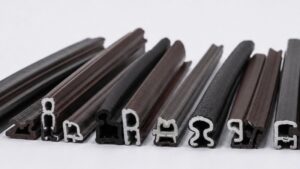
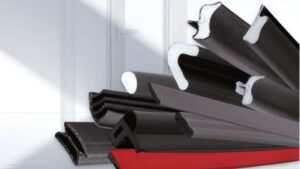
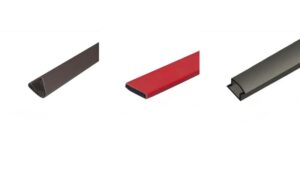
The sealing strip affects air leakage, closing force, noise control, water resistance, and long-term customer satisfaction. Coated weather strips and TPE seals can both provide reliable perimeter sealing, but they use different structures.
This guide helps you select the right material, control sourcing risks, and avoid costly profile changes after production begins.
Key Performance Differences
Cross-sectional design, compression range, hardness, groove size, and installation method can matter as much as the base material.
How Coated Weather Strips Work
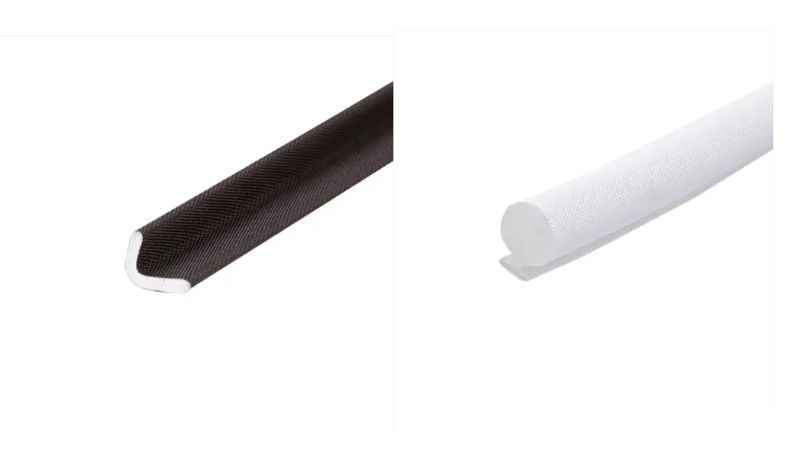
A coated weather strip normally uses a resilient polyurethane foam core surrounded by a thin protective surface layer.
This structure is useful when you want a light and quiet closing action. The foam can adapt to slight variations along a timber door, furniture panel, window sash, or frame. It also places less resistance on hinges, locks, and closing hardware than an excessively hard profile.
Selected Winguard coated strips are designed for defined gap ranges. For example, XHM217 fits clearances from 3.5 to 5.5 mm, while XHM329 is made for an installation space from 5.5 to 6 mm. Choosing a product according to the actual gap helps prevent weak contact or excessive compression.
Coated strips are a strong option when you need:
- Low closing force
- Soft contact around uneven frames
- Noise and draught reduction
- Concealed kerf-slot installation
- A clean appearance on interior or exterior doors
You should protect the coating during production and installation. Cuts, torn surfaces, excessive stretching, or incorrect groove dimensions can reduce service life.
How TPE Seals Work
TPE stands for thermoplastic elastomer. It combines rubber-like flexibility with thermoplastic processing. A TPE seal is normally extruded into its finished cross-sectional shape.
This gives you greater freedom to create hollow chambers, wide contact lips, flat sections, ribs, and mounting feet. The profile itself controls how the seal bends and distributes pressure.
For example, Winguard’s XHP04 uses two hollow cavities. These chambers act as compression buffers and help distribute pressure across the profile.
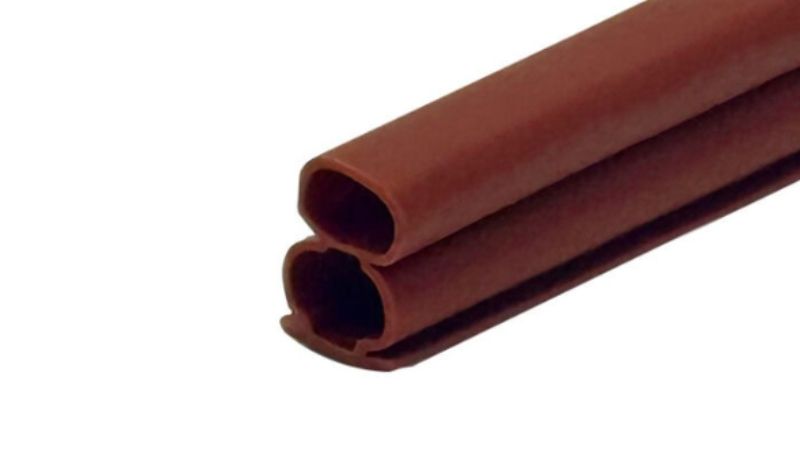
TPE can be especially useful when your door or window system needs:
- A precise extruded cross-section
- Stable slot or channel installation
- A hollow profile with controlled compression
- Smooth surface movement against the frame
- Resistance to outdoor weather and repeated use
- A recyclable thermoplastic material option
Full Performance Comparison
| Sourcing factor | Coated weather strip | TPE seal |
| Basic construction | PU foam core with protective outer coating | Extruded thermoplastic elastomer |
| Compression feel | Very soft and forgiving | Flexible but controlled by hardness and profile |
| Closing resistance | Usually low | Depends on wall thickness, cavities, and hardness |
| Uneven gap adjustment | Strong due to foam compression | Strong when the profile is designed for the gap |
| Cross-section options | Best for foam, butt-seal, and kerf-slot forms | Strong freedom for lips, ribs, cavities, and flat sections |
| Surface durability | Coating protects the soft foam | Solid outer surface resists wear and dirt |
| Material structure | Multi-material | Usually one main thermoplastic compound |
| Recycling potential | More complex due to bonded materials | Potentially easier, subject to formulation and local systems |
| Main quality risk | Damaged coating or inconsistent foam density | Incorrect hardness or dimensional variation |
| Typical use | Interior doors, entrance doors, windows, and furniture | Windows, doors, glazing, frames, and enclosures |
How Global Manufacturers Should Compare Sourcing Options
You should evaluate how the supplier controls materials, dimensions, tooling, and production batches.
Start with the Door or Window System
Do not ask for “a standard weather strip” without sharing technical details. Your supplier needs to know how the seal will function inside the finished product.
Provide:
- A 2D or 3D cross-sectional drawing
- Actual minimum and maximum gap measurements
- Groove width and depth
- Door or window material
- Opening direction and movement
- Required closing force
- Indoor or outdoor application
- Expected temperature and weather exposure
- Color and packing requirements
Measure production samples at several points. A nominal 4 mm gap may become 3 mm in one area and 5 mm in another. Your chosen profile must maintain contact across that variation.
Compare Total Cost, Not Only Price per Meter
A lower quotation does not always produce the lowest finished-door cost. A seal difficult to install can slow your assembly line. An overly firm profile may require hardware adjustment. A weak profile may lead to air-leakage complaints or replacement costs.
Your sourcing review should include:
| Cost area | Questions to ask |
| Tooling | Is a new extrusion die or profile mold required? |
| Installation | Can workers fit the seal quickly and consistently? |
| Production speed | Does the strip twist, stretch, or pull out of the groove? |
| Hardware impact | Does it increase closing or locking force? |
| Waste | How much material is lost during cutting and assembly? |
| Warranty risk | Will the material harden, flatten, crack, or detach? |
| Shipping | Can the product be supplied in suitable roll lengths and cartons? |
Coated foam may reduce operating force, which can be valuable for interior and premium doors. TPE may be more suitable when you need a profile integrated closely with an aluminum, PVC, timber, or composite frame.
Audit the Supplier’s Process Controls
For coated strips, check the foam density, coating bond, compression recovery, dimensions, and surface condition. A variation in the foam formula may change the closing feel even when the profile looks identical.
For TPE seals, check hardness, cross-sectional tolerances, cavity shape, surface quality, and material consistency. Small changes in wall thickness can affect compression force.
You should also ask how custom projects are handled. Winguard supports OEM and ODM production based on drawings or physical samples. Cross-section, dimensions, color, hardness, and length can be adjusted. Published lead times are 7–15 days for standard products and generally 20–30 days for custom products requiring new molds.
Partner with Winguard for Your Project
For Winguard, approved foam-density specifications and fixed formulas are archived for mass production. We retain labeled samples with batch, carton, and roll information for quality tracking. Our testing capabilities include raw-material checks and material-hardness testing.
Contact us today for your exact frame design. You can develop a custom sealing profile with professional material selection, controlled compression, precise dimensions, reliable mass production, and technical support.
Recommended Coated Weather Strips
- XHM217 Coated Weather Strip — Model XHM217: A 12 × 8.5 mm PU foam profile for gaps from 3.5 to 5.5 mm. It is suitable for windows, entrance doors, interior doors, sliding systems, and furniture that require balanced compression.
- XHM326 Kerf-Slot Seal — Model XHM326: A coated butt seal for interior doors and furniture. It fits a 4.5 mm groove and supports installation spaces from 3 to 4 mm, providing soft and quiet edge contact.
- XHM329 Window and Door Seal — Model XHM329: A kerf-mounted profile for gaps from 5.5 to 6 mm. Its PU foam core and coated surface suit windows and doors that need soft compression with concealed installation.
Recommended TPE Seals
- General-Purpose TPE Seal — Model XHP02: A weather-resistant profile for doors, architectural glazing, frames, and industrial enclosures. It offers elastic recovery, a smooth surface, and a recyclable TPE material option.
- Double-Cavity TPE Seal — Model XHP04: A hollow profile that distributes frame pressure through two internal chambers. It is suitable for entrance doors, exterior windows, and balcony systems requiring cushioning and insulation.
- L-Shaped Flat TPE Seal — Model XHP05: A wide-contact profile for narrow edges and uneven frame surfaces. It is designed to improve contact on casement windows, balcony doors, and aluminum frames.
Frequently Asked Questions
Which seal provides a softer closing action?
A coated PU foam strip normally provides softer compression. It is often suitable when low closing force and quiet operation are priorities.
Is TPE more durable than a coated weather strip?
Not automatically. Durability depends on the TPE compound, foam quality, coating, profile design, compression, and exposure conditions. You should compare test data for the specific model.
Which material is better for an aluminum window profile?
TPE is often well suited to precise channels and engineered frame systems. A coated strip may be better when you need softer contact or must accommodate a wider gap variation.
Can you replace a coated strip with a TPE profile?
Only after checking the dimensions and operating force. The new profile must fit the groove, cover the gap, and allow the door or window to close correctly.
Are TPE seals fully recyclable?
The thermoplastic material can have recycling potential, but collection and processing depend on local facilities. Adhesives, metal inserts, contamination, and mixed materials may affect recycling.
Can Winguard develop a custom profile?
Yes. Winguard can customize the cross-section, dimensions, hardness, color, and length based on your drawing or sample. Prototype and mass-production requirements should be confirmed before tooling begins.