In 2026, architectural sealing is becoming more closely connected with energy efficiency, material circularity, indoor comfort, and long-term building performance. Architects, door manufacturers, contractors, and distributors increasingly need products that reduce air leakage, remain flexible through changing weather, and support clearer sustainability goals. TPE seals and durable coated weather strips answer different parts of this demand.
Why Architectural Sealing Requirements Are Changing in 2026
A sealing strip affects how a door or window performs every day. A poorly selected profile may also increase the energy needed for heating and cooling.
Energy-Efficient Buildings Need Better Air Sealing
Building regulations are moving toward lower energy consumption and tighter envelopes. Publicly owned new buildings must meet the zero-emission standard from 2028, followed by other new buildings from 2030. Renovation programs are also expected to improve the performance of existing properties.
This direction affects product decisions in 2026. Developers must also reduce uncontrolled air movement around doors and operable windows.

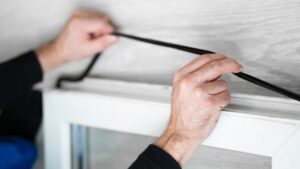
The U.S. Department of Energy recommends weatherstripping around movable building components to control air leaks. It also advises you to select a material that can handle local friction, temperature changes, weather exposure, and daily wear without making the door or window difficult to operate.
Circular Procurement Is Influencing Material Choices
Material selection is also receiving more attention. The European Commission’s circular-economy agenda aims to increase the use of high-quality secondary materials.

This does mean that buyers are asking more questions about composition, production waste, recyclability, durability, and end-of-life handling.
TPE is receiving attention because it behaves like an elastic rubber during use but can be processed as a thermoplastic. Pure TPE can be remelted and reprocessed. Production scrap can also be returned to manufacturing under controlled conditions.
Recycled-content TPE compounds are also developing quickly. Some commercial grades now contain post-industrial or post-consumer recycled material while maintaining controlled hardness and processing characteristics.
Buyers Want Evidence, Not Vague Environmental Claims
You should avoid selecting a seal simply described as “green” or “eco-friendly.” A useful environmental claim should explain what makes the product different.
This distinction is especially important when comparing TPE with coated strips. TPE may offer a simpler thermoplastic route. A coated weather strip normally combines a polyurethane foam core with a protective surface layer. Its sustainability advantage may therefore come more from durability, effective air sealing, and long replacement intervals.
TPE vs. Coated Weather Strips: Key 2026 Performance Trends
The structure of TPE and coated weather strips creates different installation and operating characteristics.
TPE Is Moving Toward Flexible Profile Design
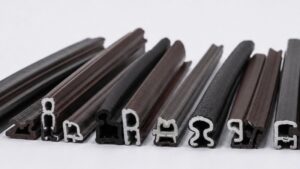
TPE seals are suitable for extruded profiles that need controlled flexibility and stable dimensions. Depending on the formula, they can resist UV exposure, temperature changes, abrasion, and long-term compression.
Winguard’s TPE range is designed to block wind, dust, moisture, heat transfer, and outside noise.
TPE is becoming attractive for several reasons:
- Reprocessing potential: Thermoplastic processing can allow controlled production waste to be reused.
- Profile flexibility: You can create solid, hollow, double-cavity, flat, or L-shaped sections.
- Material safety: Formulations can be developed without heavy metals or hazardous phthalates.
- Surface quality: A smooth exterior can reduce dirt accumulation and support clean installation.
- Weather resistance: Modified TPE can retain flexibility during hot summers and cold winters.
Coated Strips Remain Important for Soft Compression
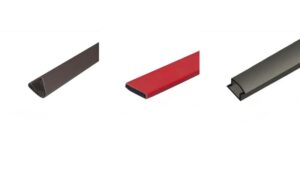
Coated weather strips usually contain a resilient polyurethane foam core and a durable outer coating. The foam provides soft contact and low closing force. The coating protects the core from moisture, UV exposure, wear, and surface damage.
This construction is useful for entrance doors, interior doors, furniture, windows, and sliding systems. It can also accommodate small frame variations more easily than a firm solid profile.
You may choose a coated strip when you need:
- Soft and quiet door closing
- Low compression force
- Strong rebound after repeated use
- Accommodation of uneven contact surfaces
- Concealed kerf-slot installation
- Protection against drafts, water, UV, and wear
A coated strip is a multi-material product, so its end-of-life route can be more complex than that of TPE. However, a long-lasting strip that maintains air sealing can still support a building’s environmental objectives by reducing premature replacement and controlling operational energy loss.
Full Performance Comparison
| Selection factor | TPE seals | Coated PU foam strips |
| Basic structure | Extruded thermoplastic elastomer | PU foam core with protective coating |
| Recyclability potential | Can be remelted and reprocessed, depending on formulation and attachments | More complex because of bonded materials |
| Recycled-content potential | Available in selected TPE compounds | Depends on individual foam and coating formulation |
| Compression feel | Flexible, with firmness controlled by profile and hardness | Very soft and forgiving |
| Profile design | Strong freedom for hollow, flat and multi-cavity shapes | Well suited to compression and kerf-slot profiles |
| Closing resistance | Low when hardness and profile are correctly selected | Usually very low |
| Weather protection | Strong with an appropriate modified compound | Outer coating protects the foam core |
| Best applications | Frames, glazing, doors, windows and industrial enclosures | Door and window gaps requiring soft compression |
| Main risk | Unsupported recycling claims or incorrect hardness | Damage to the coating or incorrect gap compression |
| 2026 buying priority | Circularity, safe formulation and profile optimization | Durability, comfort and long-term energy performance |
Custom Profiles Are Replacing One-Size-Fits-All Seals
A standard profile cannot solve every architectural gap. Door materials, frame designs, climate zones, groove sizes, and closing forces vary widely.
In 2026, you should expect more buyers to provide drawings, samples, gap ranges, and performance targets before production. A manufacturer can then adjust:
- Cross-sectional design
- Width and height
- Hollow-cavity structure
- Material hardness
- Foam density
- Surface coating
- Color and length
- Groove or kerf dimensions
This approach reduces the risk of installing a seal that is too soft, too firm, too narrow, or too large for the opening.
Develop Your Next Architectural Seal with Winguard
Winguard operates a factory of more than 15,000 square meters. Our quality system includes raw-material, hardness, swelling, and expansion testing, along with archived production formulas and batch-level sample traceability.
Whether you need a recyclable TPE profile or a soft coated weather strip, Winguard can help you match the material, cross-section, compression force, and installation method to your door or window system.
Contact us today to develop durable, energy-efficient architectural seals with professional material selection, custom profile engineering, controlled production, and reliable quality support from sampling to mass delivery.
Recommended TPE Seals
- XHP02 TPE Weatherproof Seal: A recyclable, odorless TPE profile with low compression set and resistance to UV exposure, aging, and temperature changes. It is suitable for architectural glazing, frames, doors, and industrial enclosures.
- XHP04 Double-Cavity TPE Seal: Its two hollow chambers distribute compression and create additional cushioning. It is suitable for exterior windows, entrance doors, and balcony frames that need weather, thermal, and acoustic sealing.
- XHP05 L-Shaped Flat TPE Seal: The wide flat contact surface helps cover narrow edge gaps and uneven frame areas. It is designed for windows, balcony doors, and aluminum-alloy exterior frames.
Recommended Coated Weather Strips
- XHM217 Coated Weather Strip: A 12 mm-wide PU foam profile for gaps from 3.5 to 5.5 mm. Its balanced size suits entrance doors, interior doors, windows, furniture, and sliding systems.
- XHM326 Kerf-Slot Door Seal: An 11.5 mm coated foam butt seal for a 4.5 mm groove and installation spaces from 3 to 4 mm. It provides soft edge contact for interior doors and furniture.
- XHM329 Kerf-Slot Weather Strip: A concealed kerf-mounted seal for windows and doors with gaps from 5.5 to 6 mm. Its PU foam core provides soft compression, while the PE coating adds weather and wear protection.
Frequently Asked Questions
Are all TPE seals recyclable?
TPE can generally be remelted and reprocessed because it is thermoplastic. However, practical recycling depends on the compound, contamination, attached adhesive or inserts, and available recycling facilities.
Is a TPE seal always more sustainable than a coated strip?
No. You should consider the full life cycle. A durable coated strip may provide excellent air sealing and require less frequent replacement. A TPE seal may offer easier material reprocessing. The better option depends on design, service life, and end-of-life conditions.
Which type gives you the softest door closing?
Coated PU foam strips normally provide the softest compression. They are useful when you need low operating resistance and quiet contact.
Can TPE withstand exterior weather?
Modified TPE can be formulated for UV, temperature, oxidation, and aging resistance. You should confirm the test requirements for the climate and expected service conditions.
How do you choose the correct seal size?
Measure the actual gap at several points. You should also confirm the groove width, groove depth, movement direction, and acceptable closing force. The seal must compress firmly without making the door or window difficult to operate.
Can Winguard manufacture a custom seal?
Yes. Winguard supports OEM and ODM development using your drawings or physical samples. You can customize the cross-section, dimensions, color, hardness, foam density, and length.