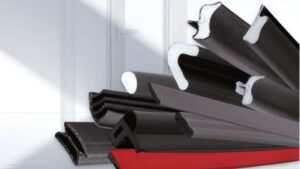
For door manufacturers, system suppliers, importers, and project procurement teams, sliding and swing door seals should be treated as different engineering applications even when they use similar materials. A swing door moves toward a frame stop and compresses the seal near the end of travel. A sliding door moves parallel to much of the perimeter, so the strip may experience wiping, drag, and shear before reaching its final closed position.
This difference changes how you evaluate the profile. A seal that is comfortable on a hinged door may create too much friction on a sliding panel. A low-friction strip that allows easy movement may not provide enough compression at the closing jamb. Some sliding systems therefore use more than one sealing principle: wiping along the moving edges and compression where the panel meets the jamb.
A reliable purchasing specification starts with door movement, contact direction, frame channel, hardware load, and expected cycle frequency. Sample approval should reproduce the actual travel path and final locking condition of the residential, commercial, or manufactured door system.
The Core Difference Is How the Door Loads the Seal
A swing door rotates around hinges. At the latch side, the closing edge approaches the frame at an angle and then compresses the seal against a stop. Near the hinge side, movement is tighter and the profile can experience more rubbing if it projects too far. The head seal also needs enough compliance to follow any door sag without making the leaf difficult to latch.
A sliding door travels along a track. The long edges can pass directly beside the seal, producing continuous surface contact. At the closing jamb, however, the final movement may press the panel into a compression strip. On lift-and-slide or multi-point locking systems, the hardware can change the direction and amount of compression at the end of travel.
| Selection factor | Sliding door | Swing door |
| Main movement | Parallel travel along a track | Rotation toward a frame stop |
| Common seal loading | Wiping, shear, and localized compression | Predominantly direct compression |
| Main operating risk | Excess drag, rolling, or pull-out | High closing force or latch resistance |
| Important checks | Surface friction, retention, track clearance | Compression range, hinge clearance, latch engagement |
What Sliding Door Weather Stripping Must Do
A sliding door seal has to control air, dust, water, and noise without turning smooth travel into a struggle. The profile should remain stable as the panel passes it. If the contact face is too soft or projects too far, it may fold over, roll in the groove, or pull free. If it is too hard, it can increase handle force and accelerate wear.
Map the sealing line before choosing the strip. Identify the head, sill, interlock, meeting stile, and closing jamb. A brush or low-friction wiping profile may be suitable along a moving edge, while a coated compression strip may be appropriate at a jamb where the panel closes against a stop. Do not assume one profile must perform every function.
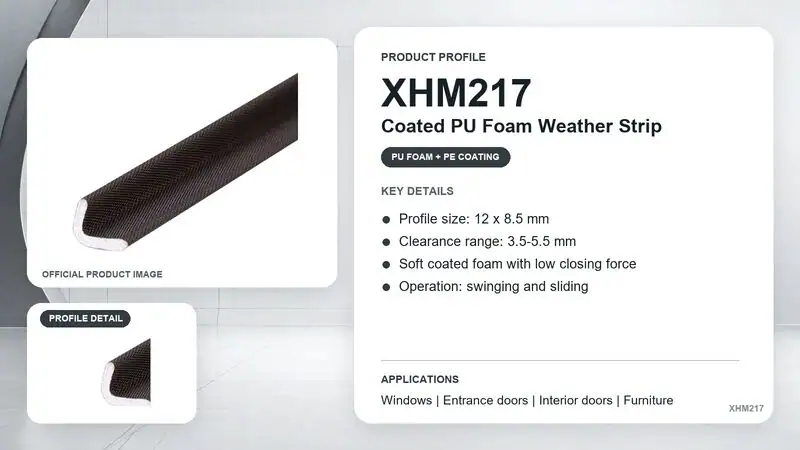
The XHM217 coated PU foam weather strip is specified for both swinging and sliding applications. Its 12 mm width, 8.5 mm thickness, and 3.5–5.5 mm clearance range define a soft-compression profile for closing contact zones. The resilient PU foam core and PE-coated surface support use on windows, entrance doors, interior doors, furniture, and related frame systems.
On a sliding system, test the profile over the full travel rather than only in the fully closed position. Watch whether the seal stays straight, twists at fasteners, catches at joints, or increases force near the end of travel. Inspect for abrasion after repeated cycles. Water management also needs separate attention at the sill; a perimeter strip should not obstruct designed drainage routes.
What a Swing Door Seal Must Do
A swing door seal mainly needs to compress predictably when the leaf meets the frame. The profile should close the leakage path while allowing the latch and closer to operate normally. If the seal is oversized, the user may need to push or pull the door hard. If it is undersized, light may remain visible and drafts or sound can pass through the gap.
Hinge-side, latch-side, and head compression create different load conditions. A smaller hinge-side clearance combined with a larger top-latch clearance indicates leaf or frame variation rather than a uniform sealing zone. Loose hinges, door sag, and frame distortion require mechanical correction; the seal covers the remaining designed tolerance.
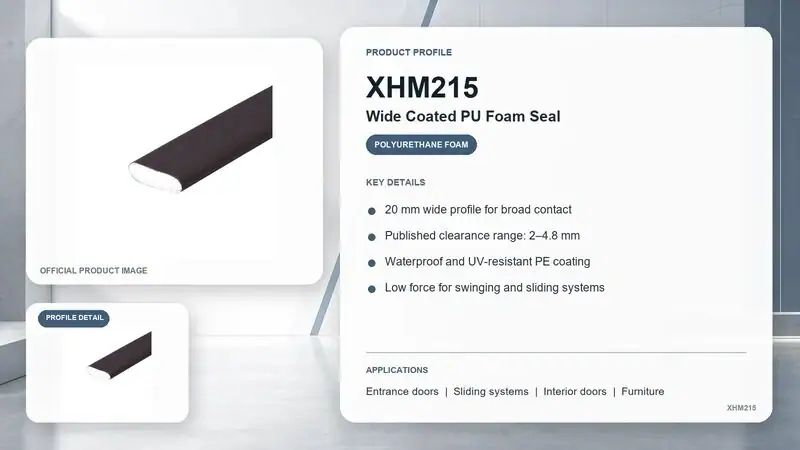
Where a swing door needs a broader contact footprint, the XHM215 wide coated PU foam seal provides a 20 mm contact width for 2–4.8 mm clearances and supports both swinging and sliding operation. Its waterproof, UV-resistant PE coating protects the PU foam core, while the low compression force limits additional operating load. The profile is designed for broad sealing contact, not for correcting hinge sag or frame misalignment.
Check the hinge side with special care. As the leaf rotates, a projecting seal can rub rather than compress. At the latch side, confirm that the strike still engages without adjustment beyond the hardware’s permitted range. If the door uses a closer, test slow closing from different opening angles and verify that the leaf latches reliably.
Divide the Perimeter Into Motion Zones
A door label such as “sliding” or “swing” is not detailed enough for seal selection. Mark each perimeter segment according to what happens during operation: continuous wiping, final compression, rotating approach, static cover, interlock engagement, or threshold contact. One doorset can contain several of these zones.
For a sliding panel, the head and long jamb may remain in wiping contact throughout travel, while the closing jamb compresses only at the end. A meeting stile may depend on overlapping profiles rather than direct compression. For a swing leaf, the latch side approaches the stop differently from the hinge side, and the sweep path can cause an exposed lip to rub before the door reaches the closed position.
- Continuous wiping zone along panel travel;
- End-of-travel compression at the closing jamb;
- Rotating contact near the hinge side;
- Interlock or meeting-stile engagement;
- Threshold contact and drainage interface;
- Hardware state when the final seal is created.
Use Different Performance Indicators for Sliding and Swinging
For a sliding edge, the primary operational indicators are travel force, friction stability, wear pattern, and retention. A seal may close the air path but still be unsuitable if handle force rises throughout the stroke or the contact face rolls after repeated movement. The important comparison is the change from the unsealed baseline through the complete travel.
For a swing door, focus on compression force, latch engagement, rebound, and contact timing. Record where the seal first touches and whether force rises sharply near the final closing angle. A profile that contacts too early at the hinge side can load the hardware even when the latch side looks correct.
Lift-and-slide and multi-point-locking systems need an additional state in the test. The panel position during free travel may differ from its locked sealing position. Record both conditions so the profile is not assessed only while the hardware is disengaged.
Run a Motion-Specific Cycle Test
Start with a baseline door using the intended rollers, hinges, closer, locks, and handle set. Install a production-representative seal length that includes a joint or corner. For a sliding system, record starting force, steady travel force, and end-of-travel force. Inspect the contact face for directional scuffing, folding, migration, and pull-out.
For a swing system, operate the leaf from several opening angles and confirm that it reaches the latch without manual assistance beyond the designed hardware action. Inspect the hinge side for rubbing and the latch side for uniform compression. After dwell under compression, reopen the door and check whether the profile returns to its original form.
If the doorset uses several hardware configurations, treat each as a separate motion condition. A heavier panel, different closer, or alternate roller set can change the load seen by the seal. The approval record should identify the hardware and movement state used during testing.
Read Failure Patterns as Motion Problems
A polished line or directional tear normally indicates wiping or shear. A permanently flattened area indicates sustained compression. A profile that walks out of its groove may have insufficient retention for the direction of travel. Local damage at the hinge side often indicates that the approach path, not only the gap, is wrong for the profile.
These patterns help separate product selection from door adjustment. Worn rollers, loose hinges, and distorted tracks should be corrected before changing the seal. Increasing profile size may temporarily create contact, but it can also add drag or closing load and hide the real motion problem.
Choose According to the Contact Zone
Sliding and swing doors are not defined by one universal strip. Divide the perimeter into contact zones, identify the motion at each zone, and select the profile accordingly. A sliding panel may need low-friction wiping along one edge and soft compression at the closing jamb. A swing door normally needs controlled compression around the stop, with special attention to the hinge side and latch force.
For a custom seal inquiry, send the door-and-frame drawing, groove dimensions, working gap and compression requirements, and an existing profile sample if available.