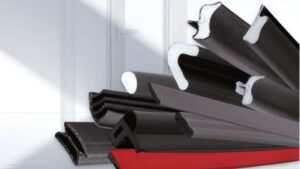
Door manufacturers, distributors, and project buyers need a seal working range derived from the actual minimum and maximum clearance. A nominal gap alone does not show what the profile must cover across production and installation tolerances.
For that reason, reliable selection starts with the actual gap range, not with the thickest strip available. A profile that is too small may leave an air, water, dust, or sound path. A profile that is too large may increase closing force, push the door out of alignment, or lose recovery after repeated compression.
A complete gap record identifies each measuring position, separates the closed-door clearance from the fixing groove, and shows whether a candidate profile can cover the complete tolerance band.
Start With the Working Gap
The most useful measurement is the working gap: the clearance that exists when the door is installed, aligned, and operating normally. Do not measure only the opening with the door wide open. The seal must work when the door is closed and the hinges, latch, and frame are carrying their normal loads.
Measure the hinge side, latch side, head, and bottom separately. On a commercial or exterior door, take at least three readings on each side. Record the smallest and largest readings. For example, a frame may have a 2 mm gap at the head and a 5 mm gap near the latch. A seal selected only for the smaller value may not contact the frame on the latch side. A seal selected only for the larger value may be over-compressed at the head.
This range is more useful than a single average because the profile has to accommodate the complete perimeter. If the difference between the minimum and maximum gap is large, first check whether the door is sagging, the hinges are loose, or the frame is out of square. A new seal cannot correct every mechanical alignment problem.
Build a Gap Map, Not a Single Measurement
Use a ruler, feeler gauge, caliper, or removable shims that will not damage the frame. Take measurements with the door in its normal closed position. Keep the following information with the project photographs or drawing:
- Minimum, maximum, and typical gap;
- Gap location, such as hinge side, latch side, head, or bottom;
- Door and frame materials;
- Groove width and depth, if a kerf-fit profile is being considered;
- Whether the door swings, slides, or seals against a threshold;
- Any rubbing, latch resistance, or visible frame movement.
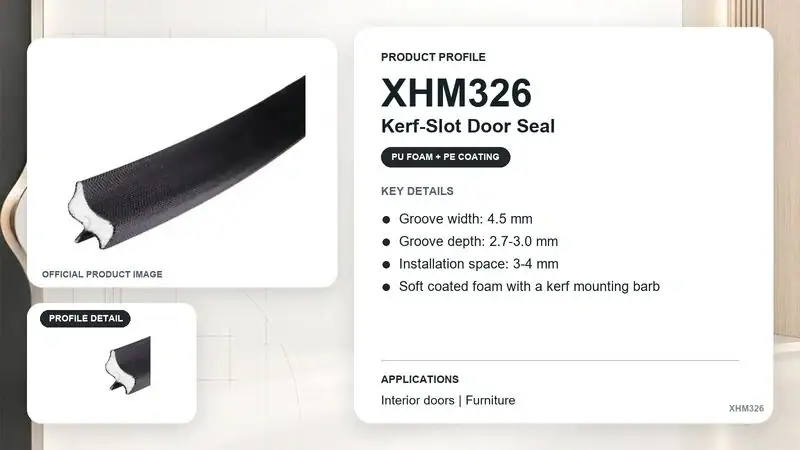
The installation groove is a separate dimension from the visible door gap. A kerf-fit seal can have the correct sealing body but the wrong fixing leg. The XHM326 Kerf Slot Door Seal uses a 4.5 mm groove width and a 2.7–3 mm groove depth, while its working installation space is 3–4 mm. These figures define two different interfaces: the kerf retains the mounting foot, and the 3–4 mm clearance loads the foam sealing body.
Adhesive-backed products require a different inspection. Check whether the surface is clean, dry, smooth, and stable enough to support the adhesive. Paint dust, oil, moisture, rough timber, and repeated peel forces can reduce the reliability of a self-adhesive installation.
Match the Seal Profile to the Gap
Small and Consistent Gaps
Small gaps that remain consistent around the frame can often be sealed with a slim kerf-fit, flat, or adhesive-backed profile. The main risk is over-compression. If the door already requires extra force to close, a thicker profile may make the problem worse.
For interior timber doors, a kerf-fit PU foam profile can provide a clean installation when the groove dimensions are controlled. The seal should be compressed enough to close the leakage path but not so tightly that the latch, hinges, or frame carry unnecessary load.
Moderate Perimeter Gaps
Moderate gaps that change slightly around the frame are often better suited to a bulb, foam, or coated weather strip with a defined compression range. These profiles can follow small variations while maintaining contact as the door moves.
The coated weather strip range is relevant when a project needs a compressible perimeter profile. Selection should be based on the measured minimum and maximum gap rather than the uncompressed thickness shown in a catalogue image.
Uneven Gaps and Exterior Frames
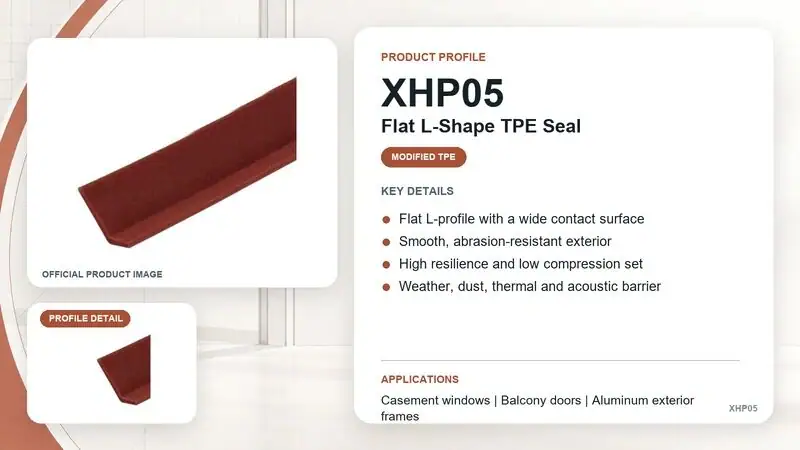
Exterior frames may need a profile that can tolerate UV exposure, moisture, temperature changes, and repeated opening cycles. A flat edge seal can be useful when a broad contact surface is needed along an aluminum frame.
The XHP05 Flat L-Shape TPE Seal uses a modified TPE profile with a broad edge-contact area. In gap-based selection, the important question is whether that contact face reaches the mating surface at the maximum clearance without being forced out of shape at the minimum clearance.
Large or Irregular Gaps
A large gap door seal is not simply a normal strip made thicker. It needs enough flexible material, profile volume, or compression travel to bridge the opening without folding, twisting, or creating excessive closing force.
When the gap is large or uneven, compare the minimum and maximum values before choosing the profile. A larger coated compression profile may be appropriate for the perimeter, while a sweep or threshold seal may be more suitable at the bottom. If the frame is badly out of square, the best long-term solution may be to correct the hinge, frame, or threshold first.
Choose the Material for the Environment
The gap determines the profile range. The environment determines whether the material will keep working.
For dry interior applications, PU foam and other soft profiles can be useful where cushioning, dust reduction, and a light closing feel are important. For exterior doors and windows, review resistance to UV, moisture, temperature changes, abrasion, and aging. TPE and other weather-resistant elastomers can be suitable when the profile must remain flexible in a wider range of conditions.
For sound control, the seal must close the leakage path without making the door difficult to operate. A heavy door with a poorly adjusted frame can still transmit sound through a small perimeter opening. The final solution may combine a perimeter seal with a bottom seal or threshold adjustment.
For fire or smoke doors, do not substitute a general weather strip for a tested fire-door sealing system. Fire seals and smoke seals should be selected for the complete door assembly and the required documentation. A generic “fire seal” label does not prove that a product is certified for a particular assembly.
Compare Samples Before Approving a Production Profile
When two profiles appear to fit the same gap, compare them under the same installation conditions. Fit a short sample to the actual groove or contact surface, then close and open the door repeatedly. Look for a continuous contact line, clean corners, stable positioning, and a latch that still works normally. A sample can reveal whether the profile rolls, buckles, catches on the frame, or pulls away at the corners.
For a project with several door sizes, test the smallest and largest representative gaps. A profile that works on a sample with a uniform 3 mm clearance may not work on a door with a 2–5 mm range. Keep the sample, drawing, and measurement record together so the approved profile can be reproduced during mass production. If the application has specified weather, acoustic, UV, or fire requirements, request the applicable test information for the selected material and assembly.
Common Mistakes When Choosing a Door Gap Seal
The most common mistake is selecting by thickness alone. Thickness does not tell you the working range, compression force, recovery, or attachment method. The second mistake is measuring one point and assuming the frame is uniform. A third is ignoring the groove: a sealing body can look right while the fixing leg does not fit.
Another mistake is using an interior strip in an exterior location without checking UV, moisture, and temperature exposure. Adhesive-backed strips also need a suitable surface and should not be treated as a universal replacement for a mechanically retained profile.
Finally, do not use a seal to hide a structural problem. If the door is sagging or the frame is badly misaligned, correct that issue before finalizing the profile. The seal should close the remaining clearance, not act as a hinge or a spacer.
When to Ask for a Profile Review
You should request a profile review when the gap varies substantially, the groove is non-standard, several door materials are involved, or the application has stated requirements for weather, sound, temperature, smoke, or fire performance. A drawing or sample is usually more useful than a product name because it shows the contact surface, fixing method, and available compression space.
If you are unsure which door gap seal fits your application, send Winguard your gap measurements, groove dimensions, frame drawing, or an existing sample through the contact form. Winguard’s custom-profile guidance specifically asks buyers to define the profile or frame drawing, groove size, working gap, material, hardness, color, length, quantity, and application conditions, and it also recommends testing a physical sample before production. This checklist is therefore based on Winguard’s published guidance; not every project will require every item.
Choose the Seal Around the Real Door Condition
The correct door gap seal is the one that matches the real gap range, the frame geometry, the operating force, and the environment. Kerf-fit PU foam is useful for a controlled groove. Coated weather strips can support durable perimeter sealing. A flat TPE edge seal can provide broad contact on an aluminum frame. A larger profile may be needed when the gap is wide, but only after the door and frame alignment have been checked.
Ready to discuss your application? Contact Winguard with your gap measurements, groove dimensions, drawing, or sample to discuss a suitable profile and sampling route.