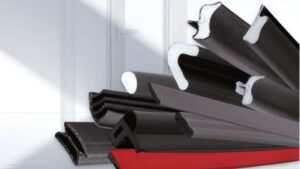
For interior door manufacturers, hotel and office project suppliers, importers, and furniture producers, the best weather strip is the profile that closes the specified perimeter gap without creating excessive operating force. Typical purchasing priorities include quiet closing, dust control, reduced air movement, neat appearance, repeatable fit, and stable supply across production batches. The thickest or firmest strip is rarely the best answer.
Interior doors also vary more than they appear to. One frame may have a routed kerf for a concealed mounting foot. Another may have a flat painted stop. The gap can change from the hinge side to the latch side, and a door that has dropped slightly can be tight at one corner but open at another. Selection therefore begins with the installed opening, not a generic door type.
An interior seal inquiry should identify the door or furniture series, routed-groove platform, closing-feel target, visible finish, and any doorset-level acoustic, smoke, or fire requirement. Coated PU foam kerf seals can then be compared within a defined timber-frame program.
Define What “Best” Means for the Room
A residential door range may prioritize softer closing and reduced light or air leakage. An office-door specification may place more emphasis on speech privacy and frequent cycling. Hotel projects require repeatable operation across many rooms, while wardrobe and cabinet programs usually require gentle cushioning, consistent color, and a clean finish.
List the priority before choosing the profile. A weather strip can reduce an open leakage path, but it does not replace the mass of the door, wall construction, threshold design, or ventilation strategy. If a room must meet an acoustic or fire requirement, evaluate the complete tested assembly rather than expecting a perimeter strip to establish performance on its own.
| Interior application | Main sealing priority | Important check |
| Bedroom or hotel room | Quiet closing, comfort, reduced drafts and light gaps | Low compression force and continuous contact |
| Office or meeting room | Reduced sound leakage and stable frequent use | Perimeter continuity and door-bottom condition |
| Wardrobe or cabinet | Cushioning, dust control, neat appearance | Small gap range and unobtrusive mounting |
| Interior fire door | Approved fire and smoke performance | Tested doorset specification takes priority |
Segment the Interior-Door Program Before Standardizing a Seal
A single building or furniture program may contain bedroom doors, meeting-room doors, service-room doors, wardrobes, and cabinets. Standardizing one seal across all of them can simplify purchasing, but only if the groove platform, closing feel, appearance, and duty cycle are genuinely compatible.
Group the openings by use before choosing a profile. Hotel room doors may prioritize repeatable latch behavior and low closing noise across many identical units. Office doors may require attention to speech leakage and higher cycles. Furniture panels may use a shallower frame section and place more emphasis on unobtrusive appearance than on perimeter weather control.
- Door-family or furniture-series reference;
- Required kerf platform and frame finish;
- Closing-feel target and expected duty cycle;
- Visible color and acceptable profile exposure;
- Corner method and installation sequence;
- Acoustic, smoke, or fire requirement at doorset level;
- Whether the same profile is intended for more than one product line.
This segmentation prevents a quiet furniture seal from being approved automatically for a higher-cycle office door, or a standard room-door strip from being treated as a substitute for a tested smoke or fire component.
Why Coated PU Foam Works Well Indoors
Coated PU foam seals combine a resilient foam core with a protective outer layer. The foam can compress gently against the door edge and recover when the door opens. This makes the construction useful where a soft contact line and low closing resistance are important.
The coating protects the core and gives the visible surface a consistent finish. It should remain intact during cutting and installation. A torn coating, stretched strip, or crushed corner can shorten service life and create an uneven contact line. The seal should be handled by the mounting portion where possible rather than pulled along the coated body.
Compared with a solid, overly firm profile, coated foam can accommodate small variations in the gap without transmitting as much force to the latch and hinges. That does not mean every foam seal fits every door. Body size, groove geometry, compression range, and corner installation still determine whether the profile works.
XHM317 for a 5 mm Kerf Groove
The XHM317 kerf-slot door seal is designed for interior doors and furniture. It requires a 5 mm groove width, a 2.7 to 3 mm groove depth, and an installation space from 4 to 6 mm. The white profile uses a resilient PU foam core with a protective PE coating and a kerf-slot mounting section for concealed retention in the routed frame groove.
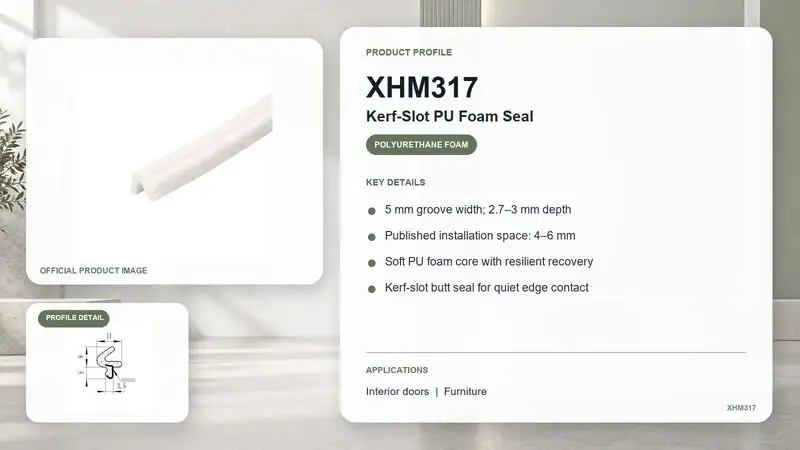
XHM317 provides concealed fixing for routed timber frames built around a 5 mm kerf. Its 4–6 mm installation space defines the working clearance loaded by the sealing body; it is not the overall product height.
During sampling, check that the barb seats without splitting the timber or pulling out at corners. Close the door slowly and inspect the contact line. The coated body should compress without folding and the latch should engage naturally. If the frame has been heavily painted, clean and measure the groove rather than forcing the profile into a narrowed slot.
XHM325 for a Different Groove and Gap Range
A visually similar product may use a different mounting dimension. The XHM325 kerf-slot door seal is intended for interior doors and furniture, but it requires a 5.5 mm groove width and a groove depth from 2.7 to 3.2 mm. Its installation space is 3 to 4.5 mm. The black coated foam body uses a compact butt-seal form and a small angled kerf barb.
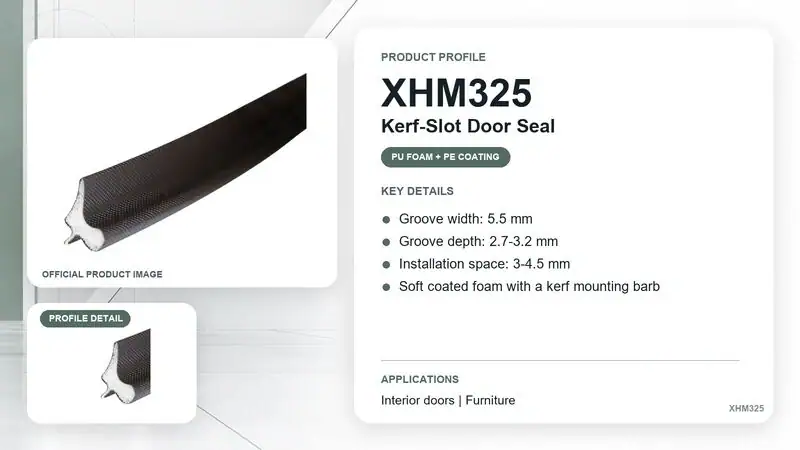
The difference between a 5 mm and 5.5 mm groove is significant at the mounting foot. Choosing by the visible sealing body alone can result in a loose or impossible fit. Compare the complete cross-section and test it in the actual routed frame. If several door suppliers are involved, verify whether they use the same kerf tooling before standardizing one profile across the project.
Do Not Forget the Door Bottom
A perimeter seal at the head and jambs cannot close a large undercut. If the goal is reduced air or sound leakage, inspect the door bottom separately. Depending on the opening, the solution may involve a sweep, drop seal, threshold, or coordinated floor clearance. The bottom device must allow the door to operate over the finished floor and should not create a trip or accessibility problem.
Intentional transfer-air openings form part of the building ventilation design and remain outside the sealing scope. Fire doors require components permitted by the tested doorset specification.
How to Evaluate Acoustic Comfort
Sound follows air paths. Closing visible perimeter gaps can help reduce leakage, especially where the existing door has no contact at the frame. However, the result also depends on the door leaf, frame joints, wall, glazing, hardware cutouts, and bottom gap. A seal should be considered one part of the acoustic path.
For offices and hotel rooms, check contact with the door fully latched. A strip that touches lightly while the door rests open may not remain continuous under actual operating conditions. Inspect corners with a light source and listen for local leakage using a consistent test method. If quantified acoustic performance is required, use appropriate assembly testing rather than relying on a material description alone.
Installation Details That Affect Performance
Clean the groove before fitting a kerf seal. Start with a straight length and press the mounting foot into the slot without stretching the coated body. Work progressively along the frame. At corners, follow the specified joint method and avoid bunching or leaving a short gap. Cut with a sharp tool that does not tear the coating or crush the foam.
After installation, close the door several times and inspect the entire perimeter. Look for sections that twist, bulge, pull out, or remain uncompressed. Check latch force and hinge-side rubbing. Reopen the door and confirm that the profile recovers rather than staying flattened.
For production programs, define which side of the profile faces the door, where joints are placed, how length is controlled, and what installation defects are unacceptable. Include these points in work instructions and incoming-quality records. A suitable profile can still perform poorly if installers stretch it, reverse it, or cut inconsistent corners.
Set Production Controls for Kerf-Seal Programs
For a routed timber frame, groove control belongs in the production plan. Define the cutter reference, groove position, acceptable coating build-up, and a simple insertion check. Tool wear can change the kerf gradually, so a profile approved on the first production batch may become loose or difficult to insert later if the machining process is not monitored.
Control installation without stretching the coated body. Specify the joint position, corner method, and cutting tool, then provide a visual reference for twisted, crushed, short, or incompletely seated sections. Inspect the finished door for recovery and consistent appearance after several closing cycles.
Do not use an ordinary interior weather strip as a substitute for a required smoke or intumescent fire seal. Similar dimensions do not establish tested performance, and a component-level description should not be converted into an unsupported claim for the complete doorset.
Select the Profile Around the Real Door
For a suitable timber frame with a controlled kerf, a coated PU foam profile can provide quiet compression, concealed fixing, and a clean interior appearance. Final approval depends on the groove, working gap, compression, door operation, color consistency, supply length, and packaging method. Sample the seal in the actual frame, test the smallest and largest production tolerances, and retain the approved cross-section and reference sample with the production drawing.
For an interior door-seal review or sample request, contact us with the gap range, groove dimensions, frame drawing, application, target quantity, packaging requirement, and an existing seal sample if available.